Power Transformers, Built for the Grid
A power transformer is used to step voltage up or down at the generation and transmission level of the electrical network — moving large amounts of power efficiently between power stations, substations, and major industrial consumers. This sets it apart from a distribution transformer, which operates at lower voltages closer to the end user. MDP Power Tech manufactures three-phase power transformers for exactly this role, engineered through a precision-driven process that begins with core selection using high-grade CRGO (cold-rolled grain-oriented) electrical steel, ensuring minimum losses and high efficiency.
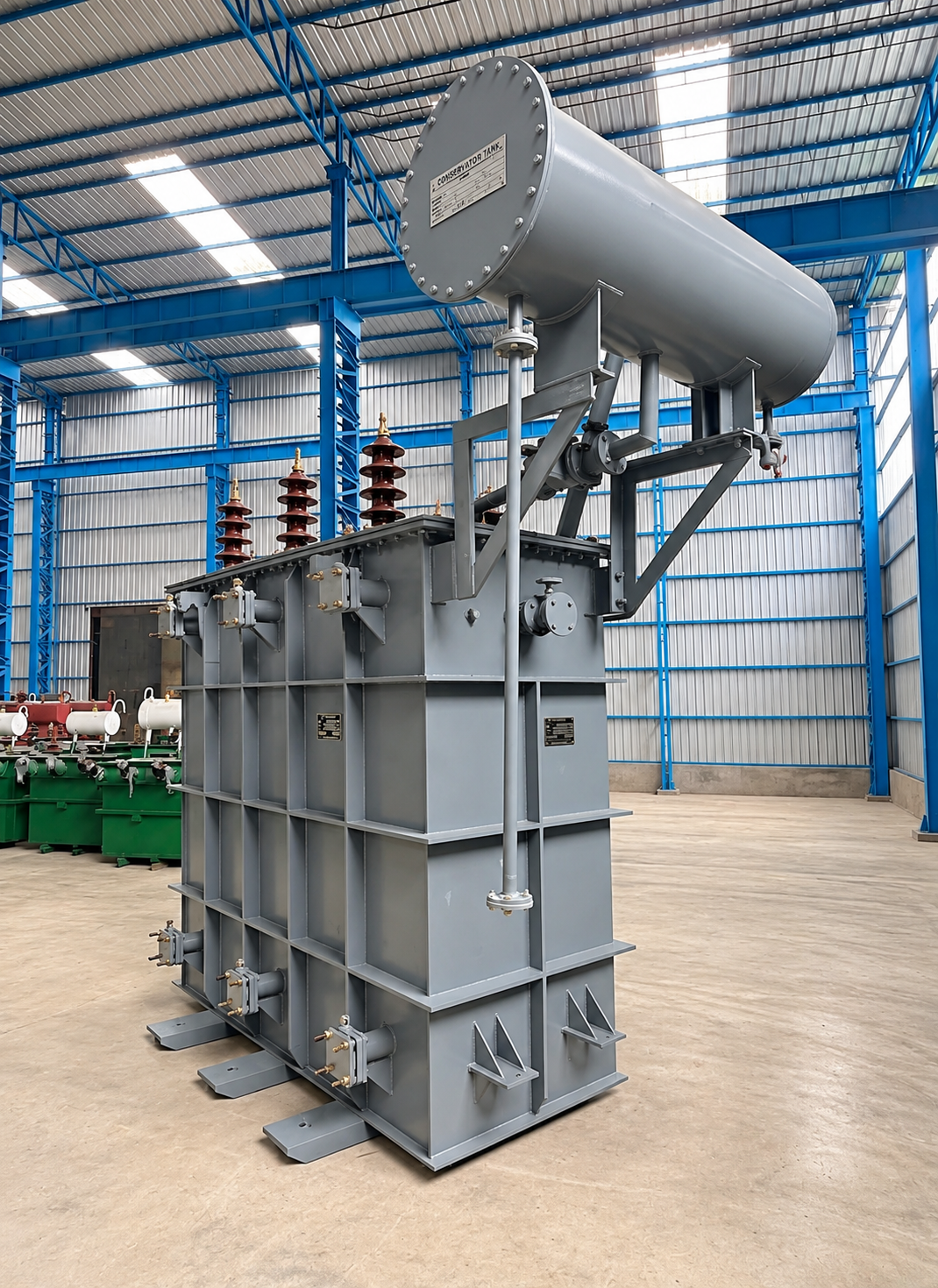
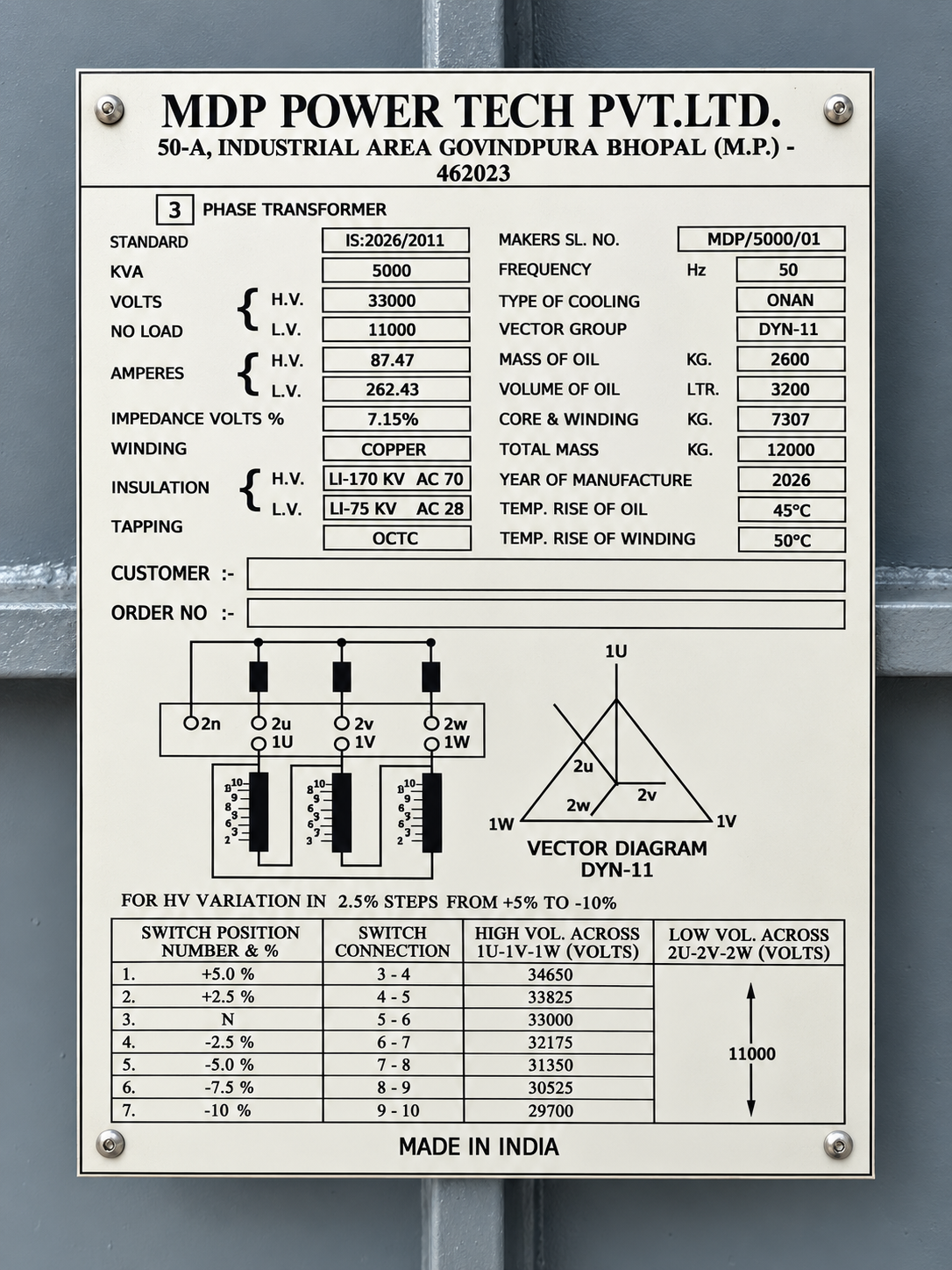
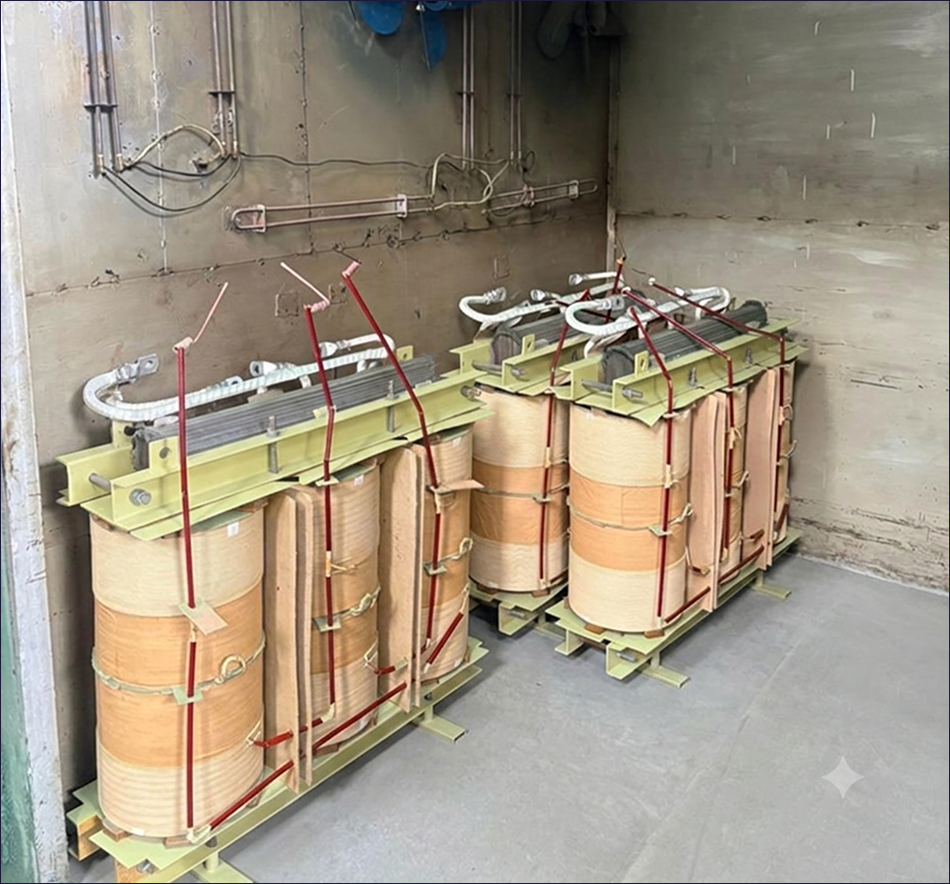
Windings are designed using copper conductors with superior insulation to achieve reliable electrical performance. The active components are assembled, dried under controlled conditions, and securely tanked to maintain structural integrity and moisture resistance — resulting in a robust, field-proven transformer built for long service life, safety, and reliable power delivery.
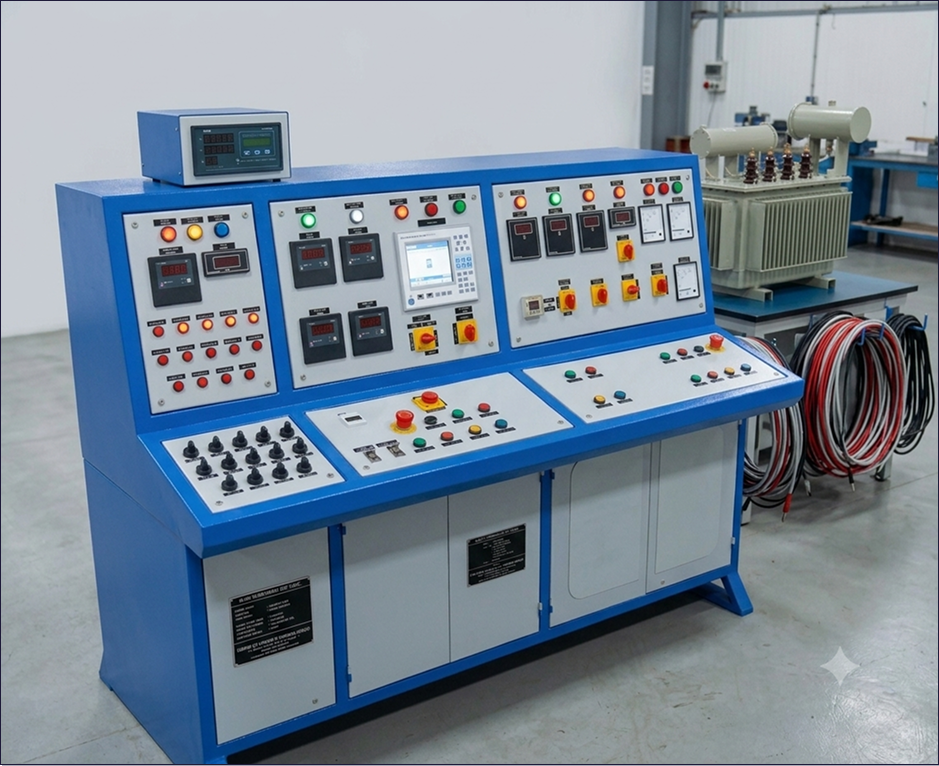
Each unit undergoes rigorous routine and type testing as per BIS standards, including efficiency, insulation, impedance, and load performance checks, before it is cleared for dispatch to state electricity utilities, EPC contractors, and industrial clients.
Whether supplying a substation upgrade, a new industrial connection, or a large infrastructure project, our engineering team works with customers to match the right configuration to the site's load profile and voltage class, so what ships is built for the application it will actually serve.
Key Features

High Efficiency
Rated efficiency of ≥98%, with voltage regulation held under 5% across the operating range.

Robust Construction
CRGO core lamination and copper windings, built to IP55 protection with Class A/F insulation.

Certified Quality
Manufactured under ISO 9001:2015 and tested to IS 2026 and IEC standards.
Technical Specifications
Full electrical and construction specifications for our standard Power Transformer range. Custom configurations are available on request.
| No. | Item | Specification |
|---|---|---|
| 1 | Power Rating | Upto 10 MVA |
| 2 | Voltage Rating | 33/11 kV |
| 3 | Frequency | 50 Hz |
| 4 | Phase | Three-phase |
| 5 | Efficiency | ≥ 98% |
| 6 | Voltage Regulation | < 5% |
| 7 | Vector Group | Dyn11 |
| 8 | Insulation Class | A/F |
| 9 | Cooling Type | ONAN |
| 10 | Core Material | CRGO (cold-rolled grain-oriented steel) |
| 11 | Winding Material | Copper |
| 12 | Impedance | 7.15% |
| 13 | Temperature Rise | 45°C Oil / 50°C Winding |
| 14 | Protection Rating | IP55 |
| 15 | Mounting | Plinth |
| 16 | Tap Changer | Off-circuit, as per customer specification |
| 17 | Testing Standard | IS 2026, IEC |
| 18 | Quality Certification | ISO 9001:2015 |
Manufacturing Process
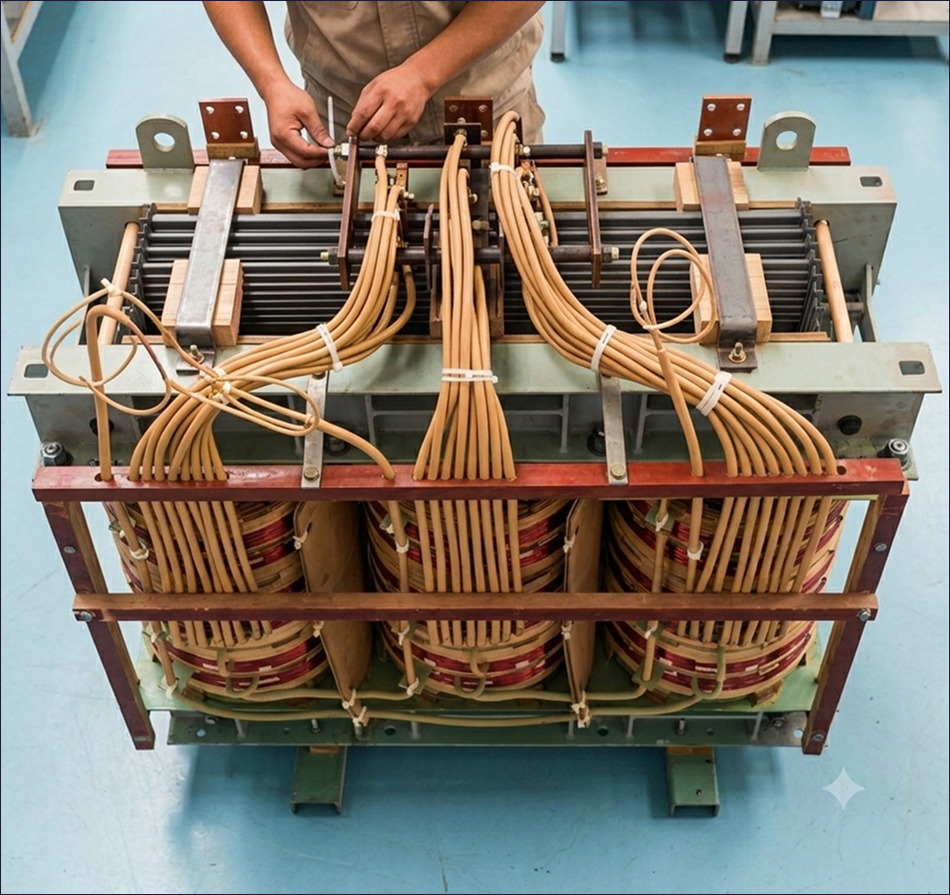
Every power transformer we build passes through a process-driven, quality-controlled manufacturing sequence — starting with the core and coil assembly. The transformer core is built from high-grade CRGO electrical steel laminations, precision-cut and stacked to form an efficient magnetic circuit that minimizes core losses. Copper windings are wound and insulated to exact specifications, then assembled around the core with controlled clamping pressure to ensure mechanical strength, dimensional accuracy, and optimal electrical performance.
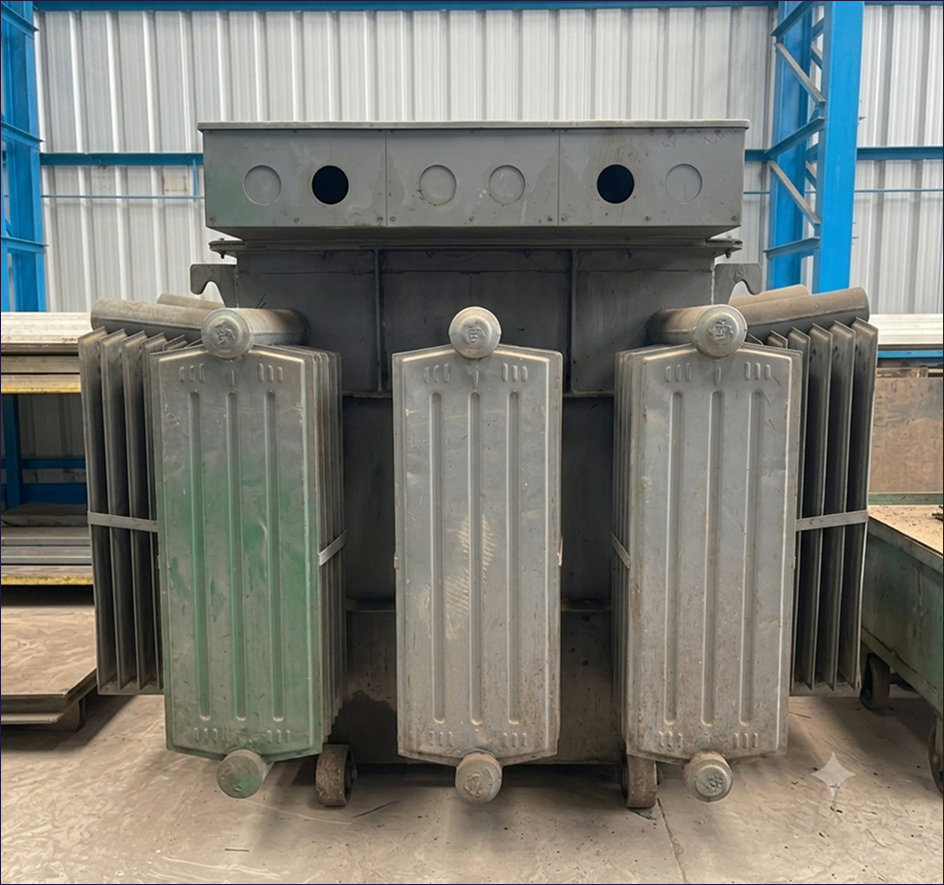
The transformer tank is fabricated from heavy-gauge mild steel sheets, cut and welded to precise dimensions to house the core-coil assembly. Radiators and cooling fins are integrated for effective heat dissipation, and the tank undergoes surface treatment and rigorous leak testing before being sealed for oil filling — ensuring long-term durability and protection against environmental stress.
This disciplined, stage-by-stage approach — combined with skilled manpower and a state-of-the-art plant designed for high productivity and low cycle times — is what allows us to hold a consistent standard across every unit that leaves the factory floor, regardless of order size.
Testing & Quality
Post assembly, the core-coil unit undergoes vacuum drying to remove residual moisture trapped within the insulation and windings. Using controlled temperature and high-vacuum conditions, this process ensures the insulation system is completely dry before oil impregnation, significantly enhancing the transformer's dielectric strength, insulation life, and long-term reliability.
The tank is then filled with high-dielectric-strength transformer oil under vacuum conditions to eliminate moisture and air pockets. Each unit undergoes a comprehensive round of routine and type tests as per IS/IEC standards — including insulation resistance, winding resistance, voltage ratio, no-load and load loss, temperature rise, and high-voltage withstand tests — with quality checkpoints verified at every stage before certification and dispatch.
Our manufacturing operations are certified to ISO 9001:2015, and our designs are type tested in NABL-accredited laboratories including CPRI and ERTO, India. Every transformer we manufacture is type tested, covering Temperature Rise and Lightning Impulse Short Circuit tests among others, and every rating is held to the maximum total loss limits set out under BIS guidelines.
Where Our Power Transformers Are Used
Built to perform reliably under demanding conditions, our power transformers support a range of applications across the power distribution and industrial landscape.
State Electricity Utilities & Substations
Supporting substation upgrades and grid strengthening programs for state DISCOMs, with units built to utility voltage and reliability standards.
EPC Contractors & Infrastructure Projects
Supplying EPC contractors executing turnkey power infrastructure and electrification projects across Madhya Pradesh and beyond.
Industrial & Commercial Facilities
Powering manufacturing plants, commercial complexes, and industrial estates that need dependable, high-load power transformation.
Large-Scale Development Projects
Serving hospitals, residential developments, and other large facilities where consistent, safe power delivery is critical.
Frequently Asked Questions
What's the difference between a power transformer and a distribution transformer?
A power transformer operates at the generation and transmission stage, moving large amounts of power at higher voltages — typically at or near substations. A distribution transformer steps voltage down further, to the level actually delivered to homes, shops, and small industrial connections.
What information do you need to quote a power transformer?
To give you an accurate quote, we typically need the required capacity (MVA), primary and secondary voltage, vector group, tap requirement, and any site-specific conditions — along with the applicable testing standard.
What is your typical lead time?
Lead time depends on the transformer's rating, current production schedule, and testing requirements. Get in touch with our team for a project-specific estimate.
Can I witness testing on my order?
Yes — customer or third-party witnessed testing can be arranged on request, alongside our standard routine and type testing to IS/IEC standards.
Do you supply outside India?
We currently supply within India, serving state electricity utilities, EPC contractors, and industrial clients across Madhya Pradesh and neighbouring regions.